
Built for Public sector. Designed for Compliance. Trusted for Results.
GRAP 104(R) Expected Credit Loss solutions are purpose-built to help municipalities and public sector entities navigate the complexities of GRAP 104 with confidence. Our intelligent ECL framework combines advanced analytics, automation, and audit-ready reporting to transform complex impairment requirements into a streamlined and efficient process.
We help finance teams move beyond spreadsheets and manual calculations by delivering transparent, forward-looking, and fully compliant ECL solutions.

Why Choosing Municipal ECL Consultants?
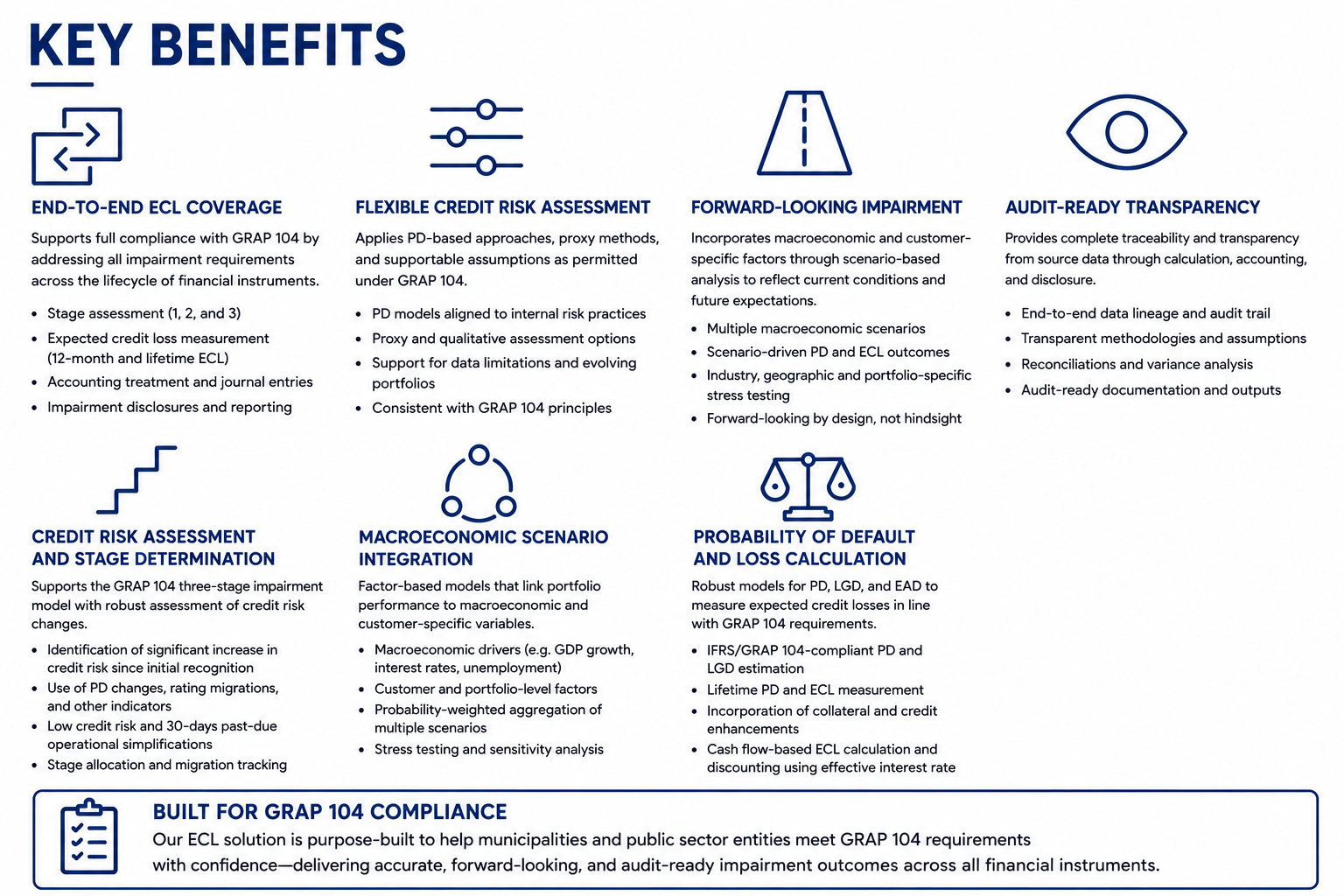
End-to-End ECL Coverage
Our solution supports the complete impairment lifecycle under GRAP 104:
- Stage assessment and credit risk evaluation
- 12-month and lifetime ECL measurement
- Accounting treatment support
- Financial statement disclosures
- Automated reporting and audit outputs
We manage the complexity so your teams can focus on strategic financial decision-making.
Forward-Looking Intelligence
MECL is designed around predictive analysis rather than historical assumptions.
Our models incorporate:
✔ Macroeconomic indicators
✔ Scenario-based forecasting
✔ Customer and portfolio-level risk factors
✔ Probability-weighted outcomes
This ensures impairment calculations reflect changing economic realities and future expectations.
Advanced Credit Risk Analytics
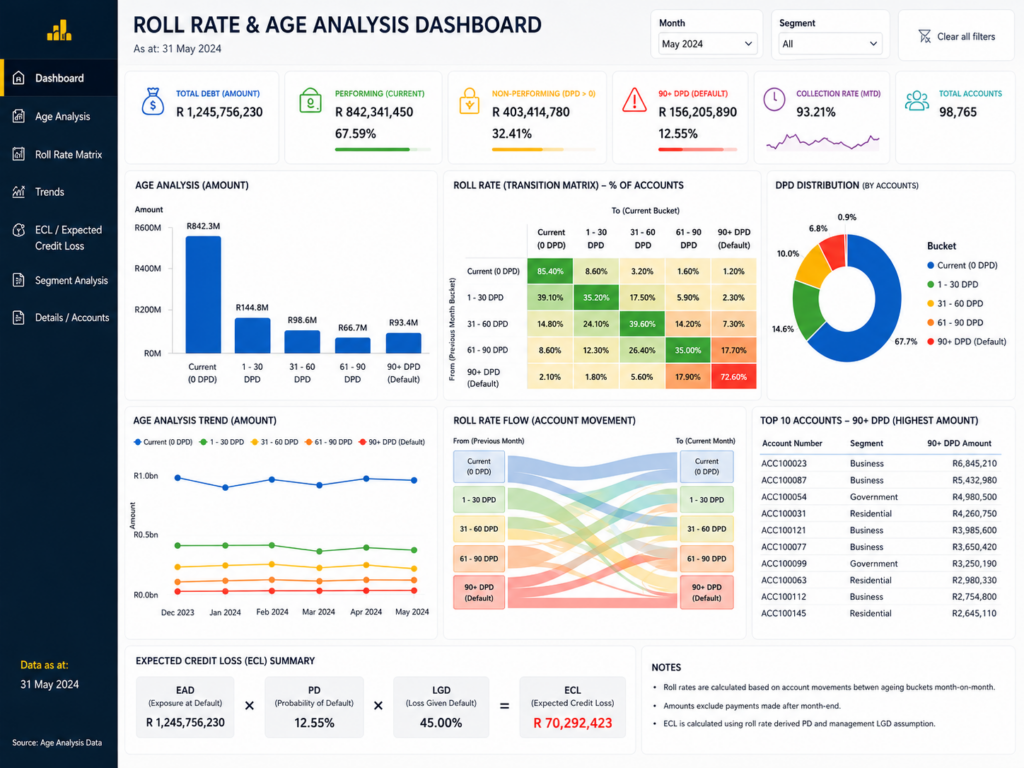
Our framework enables deeper understanding of municipal portfolio performance.
Capabilities include:
✔ Credit risk segmentation
✔ Portfolio-level analysis
✔ Probability of Default (PD) methodologies
✔ Loss analysis by municipal service categories
✔ Performance trends and cohort reporting
This creates greater visibility into risk drivers and portfolio behavior.
Audit-Ready Transparency
Transparency is at the core of our methodology.
Our solution provides:
✔ Full data lineage and traceability
✔ Documented methodologies
✔ Model assumptions and governance records
✔ Detailed reconciliation reporting
✔ GRAP 104-compliant disclosure outputs
This helps reduce audit effort and minimizes year-end reporting pressure.